The Historic Journey of the Artemis II Astronauts
A New Era in Space: Discover The Historic Journey of the Artemis II Astronauts
S
Sarah ChenSenior Developer & Writer
4 min read765 words
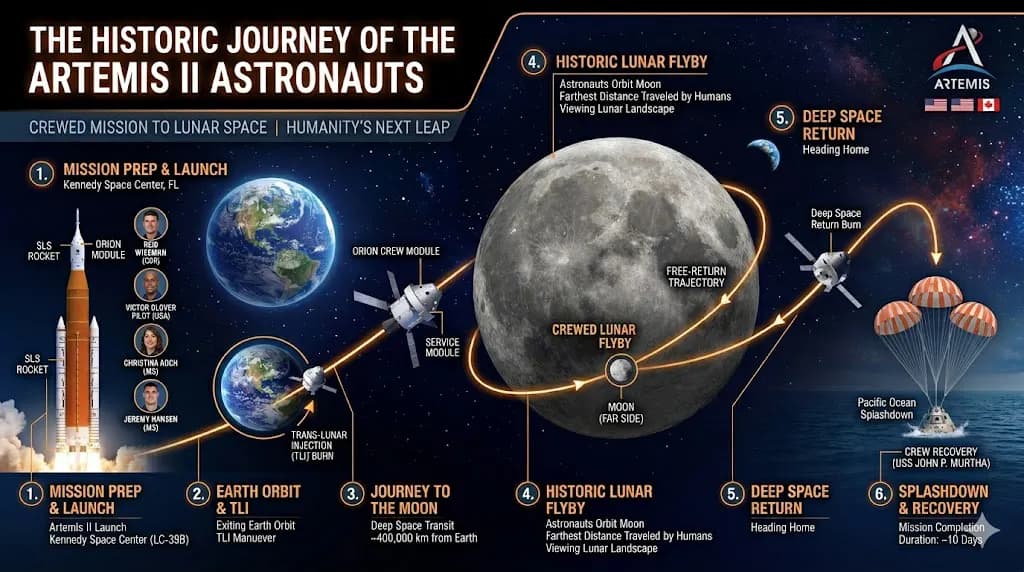
Humanity has finally returned to the moon. On April 1, 2026, the night sky above Florida lit up. NASA launched the highly anticipated Artemis II mission. This launch marked a monumental milestone in space exploration.
For the first time in over fifty years, astronauts are traveling beyond low Earth orbit. They are not just visiting space. They are charting an entirely new course for human history. The massive Space Launch System (SLS) rocket roared to life.
It successfully propelled the Orion spacecraft into the cosmos. Inside the capsule sat four brave explorers. Their ten-day journey is currently capturing the imagination of the world.
The Groundbreaking Crew
This mission represents all of humanity. The crew of four includes three Americans and one Canadian. They bring diverse backgrounds and incredible expertise to the mission.
Reid Wiseman serves as the mission commander. He is a seasoned naval aviator and a veteran astronaut. Victor Glover sits beside him as the pilot. With this historic flight, Glover has become the first person of color to fly a lunar mission.
Christina Koch is serving as a mission specialist. She already holds the record for the longest single spaceflight by a woman. Now, she is the first woman to ever fly to the moon. Jeremy Hansen joins them from the Canadian Space Agency. He is the first non-American to ever leave Earth’s orbit.
Together, they form the ultimate space exploration team. They represent a modern, inclusive era of spaceflight. This new era is built on international partnerships and global unity.
The Journey and The Spacecraft

The journey relies entirely on cutting-edge technology. The Orion capsule is a modern engineering marvel. It is specifically designed to keep astronauts safe in deep space.
During their first day in orbit, the crew thoroughly tested the capsule. They checked the complex life support systems. They also practiced manual piloting maneuvers near Earth. Once Orion passed all safety tests, it was time to go much further.
A massive engine burn pushed them out of Earth’s orbit. This critical move is called the trans-lunar injection. It sent the spacecraft hurtling toward the moon at incredible speeds.
The trip outward took about four days. The astronauts used this time to monitor the ship closely. Every button pressed and dial turned provided vital data. This data will ensure future lunar landings remain safe.
Making History in Lunar Orbit
On April 6, 2026, the crew made history once again. They performed a daring, high-speed lunar flyby. Orion skimmed just over 4,000 miles above the moon’s heavily cratered surface. Then, they flew directly around the far side of the moon.
As they did, they lost communication with Earth for forty minutes. This radio silence was totally expected. However, it was still a highly dramatic moment for Mission Control in Houston.
During this radio blackout, the astronauts saw something truly magical. They witnessed a total solar eclipse from the moon's far side. The massive moon completely blocked the sun.
This gave them a rare, stunning view of the sun's glowing corona. Shortly after, they watched a breathtaking "Earthrise" as our blue planet emerged over the lunar horizon.
They even named two lunar craters during their flyby observations. One was named "Integrity" after their capsule. The other was named "Carroll" to honor Commander Wiseman's late wife.

Furthermore, they shattered a major spaceflight record. Artemis II traveled over 252,700 miles away from Earth. This officially breaks the long-standing distance record set by the Apollo 13 mission in 1970. Humanity has literally never ventured this far into the dark void of space.
Looking to the Future
Artemis II is a vital stepping stone. The crew will not walk on the moon this time. Their mission is a crucial, high-stakes flight test. They are proving that the Orion spacecraft works perfectly under extreme pressure.
This success paves the way for Artemis III. That future mission aims to actually land humans on the lunar surface. The current astronauts are now heading home. They used the moon’s gravity to slingshot back toward Earth.
A safe splashdown in the Pacific Ocean is scheduled for April 10. Their safe return will signal a massive victory for NASA and its international partners.
The Artemis II mission is much more than a test flight. It is a brilliant symbol of human ambition. These four astronauts are pushing the absolute boundaries of what is possible.
They are inspiring a new generation of scientists and dreamers. The moon is no longer just a destination. It is our stepping stone to Mars.